The Forgotten Ballad to Unrequited Love: The Original Little Mermaid

“Far out in the ocean the water is as blue as the petals of the loveliest cornflower, and as clear as the purest glass. But it is very deep too. It goes down deeper than any anchor rope will go, and many, many steeples would have to be stacked one on top of another to reach from the bottom to the surface of the sea. It is down there that the sea folk live.”

Or so the story of Hans Christian Andersen’s “The Little Mermaid” begins.

I had always known that the Disney version of “The Little Mermaid” was vastly different from the original. I had heard that the original was sad, heartbreaking, horrible. I had assumed it was some sort of twisted tale from the dark ages, unfit in its darkness for the children of today.

But oh, I was so surprised then, when I eventually did find my way to the original story. Yes, it’s sad – or has its sad elements. But it’s also so very beautiful.

Bertall_ill_La_Petite_Sirène2

Now, the 1989 Disney adaptation of “The Little Mermaid” is great. It’s enchanting and funny and lovely– but the thing is, it seems very much to be its own story, and a different story from the story Hans Christian Andersen told. And we can’t forget that before the 1989 film, in fact before Disney was a company, before Walt Disney the man was even born, before his parents in fact were born, the story of “The Little Mermaid” had enchanted thousands of people (millions perhaps?) in its own right. First published in 1837, it has stood the test of time. Or at least, it seems to have, until we realize that “The Little Mermaid” story most of us know isn’t at all the one of Hans Christian Andersen.

Shall we start with how the real story ends? In Andersen’s “The Little Mermaid”, the little mermaid doesn’t get to marry her Prince. In fact, she dies, completely heartbroken. Sad and tragic? Yes. Beautiful? Just wait.


[The Real Story]

She doesn’t get the Prince. And yes, it is sad, but it has to be so. Because, as I’d like to explain, “The Little Mermaid” is a ballad for unrequited love, for the persistent, brave, foolhardy love that continues quietly even as it is unappreciated, unrecognized, and unseen.

And in this story and for the sake of her love, the little mermaid gives up so much. In addition to losing her voice and to forsaking her family and home, she endures great pain. Her transformation of tail to legs comes with tortuous agony, as if a sharp sword slashed through her. And although she is graceful and beautiful and lovely, each step she takes on human legs feels as if she is treading of a bed of knives that pierce her skin as she walks.
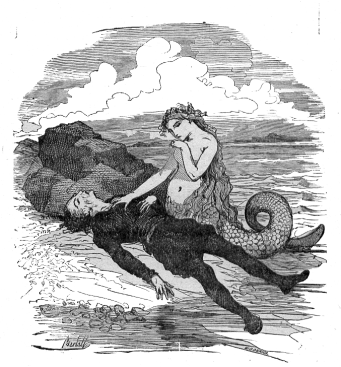
Bertall_ill_La_Petite_SirèneCoupled with the physical pain is the emotional. The Prince, foolish man, longs for the girl that saved him, for the voice and the song of the girl that saved him. Of course, we all know the Prince’s dream girl is in fact the little mermaid, but she cannot tell him. And so she suffers, as the Prince continues to see her only as an innocent child. His heart, he tells her, is saved for the girl that saved him. It is this girl and not the little mermaid that he desperately wants to find, to marry. But still the little mermaid hopes. The Prince spends time with her and cares for her and even speaks of the possibility of marrying her. Her hope must grow so large.

In the end, the Prince marries another, a girl he thinks is the girl that saved him, but of course, isn’t. And the little mermaid is given the opportunity to win back her life with her family, to return to life as a mermaid, if she can kill the Prince as he sleeps. But, she loves him, and so she can’t.

Instead as part of the bargain she made with the sea witch, she dies, turning into sea foam.


But here, Andersen is able to deliver the ultimate judgment. Instead of simply perishing as sea foam as other mermaids do (we are told earlier that, unlike humans, mermaids do not have afterlives), the little mermaid becomes a daughter of the air. In exchange for her goodness, for her suffering, and her loyalty, she is given the chance to win immortality, to win an immortal soul.


“You, poor little mermaid, have tried with your whole heart… Your suffering and your loyalty have raised you up into the realm of airy spirits, and now in the course of three hundred years you may earn by your good deeds a soul that will never die.”


So you see? It’s sad, but it’s so much more complicated than that. She loves with an intensity and a passion that is unreturned and unappreciated, but that has worth in its own right, for what it is. And this love is ultimately recognized. In the story, recognition comes from the spiritual realm. But for those of us who are less spiritual, this redemption comes also a metaphor for simple truth. Goodness, although not recognized, is still goodness and evil, though it may go unnoticed, is still evil. Andersen gave the little mermaid spiritual redemption but he also gave her ultimate recognition for what she is and for what she has done.

And although fantastical, perhaps it’s closer to truth than the Disney version. In real life, much of love is unreturned. Real life and real love can be difficult, heartbreaking even. I am reminded of David Whyte’s description of heartbreak in his book Consolations,


Heartbreak is unpreventable; the natural outcome of caring for people and things over which we have no control…

Heartbreak begins the moment we are asked to let go but cannot, in other words, it colors and inhabits and magnifies each and every day; heartbreak is not a visitation, but a path that human beings follow through even the most average life. Heartbreak is an indication of our sincerity: in a love relationship, in a life’s work, in trying to learn a musical instrument, in the attempt to shape a better more generous self.


And so, instead of only celebrating the successful kind of love that ends in marriage, perhaps we should also honor the more difficult types of love too. Perhaps we should honor the nobleness, the purity of the unrequited love in each other.

Leonard Cohen once said, we usually don’t deserve the love we expect. And I would add, neither do we receive the type of love we deserve. Instead, we love others with the type of love we deserve, hoping for something in return.


Little-Mermaid-Proteus-1887


For further reading (and viewing): Enjoy the full text of Hans Christian Andersen’s “The Little Mermaid”. For film adaptations more true to the original text, see if you can find copies of Rusalochka (Russian), Anderusen Dōwa Ningyo Hime (Japanese), and The Little Mermaid by The Reader’s Digest.  More on David Whyte’s Consolations.

“Gastronomy is the Art of Using Food to Create Happiness”

“Gastronomy is the art of using food to create happiness,” writes Theodore Zeldin.

Zeldin, both a philosopher and a historian has dedicated much of his life to discovering what it means to be human and what it means to be happy. One of his books, An Intimate History of Humanity, is a treasure. Each chapter explores a different theme, emotion, or element of the human life. Examples of chapter titles include, “How men and women have slowly learned to have interesting conversations” and “Why the crisis in the family is only one stage in the evolution of generosity.”

Underlying all his writing, regardless of the subject, is the common thread of pleasure and happiness – and it is no different in his exploration of our relationship with food.

Eating is one of the most basic ways by which we experience pleasure. Zeldin posits that our approach to eating and receiving pleasure from eating mirrors our broader approaches to pursuing other types of pleasure in life.


spices-667115_1920

According Zeldin, there are Three Ways of Eating and each corresponds to a different way of searching for happiness.

Zeldin’s Three Ways of Eating:

1) Eating until one is full

“The first and most traditional way, putting faith in old recipes and well-tried methods. The aim is to be contented, to be comforted, to feel cozy, to purr. This is the cautious approach to pleasure, with the motto ‘Protect yourself from foreign bodies.’”

This is a search for contentment, for satiation, in a way that is safe and without risk or danger (and excitement).

2) Eating as amusement

A second way of eating is, “treating food as an amusement, a form of permissiveness, a caress of the senses,” “creating conviviality around delicious odours.”

This variety of a search for happiness is for temporary relief from ordinary hardship, in the one who “yearns for distractions and surprises, who seeks a different kind of happiness in frivolity in being jokey, cynical, ironical, refusing to be made permanently miserable by the big problems, like starvation and stupidity.”

3) Food as a means of exercising creativity

“When peace and quiet, or wit and detachment, began to pall, a different yearning was born, to make a personal, original contribution to life. The search for a third kind of happiness – which moderns call creativity – demanded a way of eating which corresponded…

Creative cooks found qualities in food that nobody suspected were there, uniting ingredients that never used to mix. Creative diners are constantly engaged in losing their fear of strange foods, and of foreign bodies.”

With this third way of eating, cooking and eating become forms of art. Cooking is another medium for expression and our food, the canvas and materials through which we can create.

“Every time a recipe is not strictly followed, every time a risk is taken with changed ingredients or proportions, the resulting food is a creative work, good or bad, into which humans have put a little of themselves.”


His point with these three ways of eating, he is careful to note, is not to categorize us into “three different kinds of people, each of them stuck with their habits.” No, rather, it’s to suggest that there may be more to the way we cook and eat than may appear at surface level.

Zeldin likely hopes for more of the third way of eating. I direct you to this final paragraph from the text, which (with an idealism that appears in most of Zeldin’s work) expresses well his belief that there is much more to learn from how we eat and also his hope for further “exploration on the whole of nature” and “ever-widening horizons of pleasure and understanding.”

Hunger is still being satisfied without full awareness of what it is one is hungry for. Some delicious foods have no nutritional value, others are disagreeable until a taste for them is acquired, others still do not stop one feeling hungry but stimulate one to eat yet more, to prolong the pleasure of eating, like a lover seeking to prolong an embrace. Trying to make sense of such behavior can clarify a lot more than one’s taste in food – for example, how far one is interested by new sorts of pleasure, or innovation and creativity in general, whether one is willing to risk disappointment or failure, whether one wants to be brave and free more than to be applauded, whether one likes to discuss one’s pleasures, whether one enjoys giving pleasure to others. Gastronomy is a branch of knowledge in its infancy, focusing not just on self-indulgence but on exploration, not just on self-exploration but on the exploration of the whole of nature. It can look forward to ever-widening horizons of pleasure and understanding, even though it has its dark side, for it has done little to deal with the obscenities of famine and cruelty, and it will perhaps only receive proper recognition when it does. Nevertheless, forks and spoons have probably done more to reconcile people who cannot agree than guns and bombs ever did.


Ralph Waldo Emerson on Self-Discovery and Learning

A Life of Self-Discovery: Guidance from Ralph Waldo Emerson on Learning About Ourselves


One could argue that the heart of Emerson’s true education occurred outside of the classroom. Although he attended Harvard University, he was an unexceptional student who graduated without distinction. He felt at odds with his peers and kept mostly to himself. He however read extensively and throughout his life was exposed to and influenced by the ideas of those such as Thomas Carlyle, Montaigne, Goethe, and Swedenborg. His true education, he conducted himself.

6908d0d4a2fbd7296fa4efab5fd1c241d4f37c33Emerson and the Transcendentalists believed in the strength of the individual and in the greatness of the individual human spirit. He believed that there is genius, beauty, and wisdom within each of us, if we listen to and find it. By nurturing oneself, listening to oneself, and by learning from one’s experiences and emotions, one can discover one’s own truth and self. And this process of discovery is both the journey and the end goal of life.

Emerson was thus on a lifelong journey to discover himself and his writings are his chronicles of that journey.


Learning as an Individual Task

Ultimately and above all else, he champions the importance of determining one’s truth by oneself. Learning is not done by imitation or by conforming to what others do or to what society might expect us to do. Each of us is different and therefore what is right and true for each of us will be different. The below is taken from his seminal essay, Self-Reliance.

There is a time in every man’s education when he arrives at the conviction that envy is ignorance; that imitation is suicide; that he must take himself for better, for worse, as his portion; that though the wide universe is full of good, no kernel of nourishing corn can come to him but through his toil bestowed on that plot of ground which is given to him to till.

Thus, we must each do our own work on ourselves, in our own way.

He warns against the temptations and dangers of conformity,

What I must do is all that concerns me, not what the people think. This rule, equally arduous in actual and in intellectual life, may serve the whole distinction between greatness and meanness. It is the harder, because you will always find those who think they know what is your duty better than you know it. It is easy in the world to live after the world’s opinion; it is easy in solitude to live after our own; but the great man is he who in the midst of the crowd keeps with perfect sweetness the independence of solitude.


There are no Shortcuts

And he argues that in order to know something, you have to go through the process of obtaining the knowledge yourself. There are no shortcuts to really knowing,

Every mind must know the whole lesson for itself, – must go over the whole ground. What it does not see, what it does not live, it will not know. What the former age has epitomized into a formula or rule for manipular convenience, it will lose all the good or verifying for itself, by means of the wall of that rule. Somewhere, sometime, it will demand and find compensation for that loss by doing the work itself. Ferguson discovered many things in astronomy which had long been known. The better for him.


Learning from Real, Raw Experience

Really knowing thus comes from the process of the mind ‘go[ing] over the whole ground.’ And this process of ‘knowing’ can take many forms. Ever the intellectual, Emerson nevertheless extols the knowledge that can only be gleaned from real, raw life,

Who knows himself before he has been thrilled with indignation at an outrage, or has shared the throb of thousands in a national exultation or alarm? No man can antedate his experience, or guess what faculty or feeling a new object shall unlock, any more than he can today the face of a person whom he shall see tomorrow for the first time.

And to some degree, he chases these feelings, even those of a darker shade,

There are moods in which we court suffering, in the hope that here, at least, we shall find reality, sharp peaks and edges of truth.

The world is our classroom and just as “the child amidst his baubles, is learning the action of light, motion, gravity, muscular force” so “in the game of life: love, fear, justice, appetite, man, and God interact.


It All Comes Back to Ourselves

And for Emerson, all his efforts towards learning are always somehow in the end, directed back towards himself, for to Emerson, oneself is the beautiful mystery. He writes,

We go to Europe, or we pursue persons, or we read books, in the instinctive faith that these will…reveal us to ourselves.


Well, what was the good of that?

A brief reflection on Public Displays of Anger.

london-726443_1280

Once, while at Heathrow getting breakfast, I witnessed a little scene. It wasn’t anything big or unusual, but it was indeed a scene.

“And how is everything?”

The waiter walks up to a table where mother and daughter are sipping on the icy remains of smoothies. The daughter looks about ten years old, dressed in her travel clothes, comfortable – grey sweatpants and a grey and pink long sleeved shirt. Straight hair and a bit of a sullen expression, she’s hunched over her smoothie glass, noisily sucking up air and chunks of ice. The mother perks up at the waiter’s approach, and you can tell she’s been waiting, dying, for someone to ask.

“Well, I’m not too happy with your seat discrimination policy,” she announces loudly. I close the cover on my iPad. She has my attention.

The waiter starts, clearly not expecting this. “I’m sorry?”

“Your colleague,” she demands, “Let me speak with your colleague.” And her finger hooks in the air at the young hostess in the front of the cafe.

Soon the hostess has been summoned, and it begins.

“Right,” she starts. Just so you are here with me, you have to imagine her with this strong English accent – think Hyacinth Bucket from Keeping Up Appearancesand so this, “Right” comes out full force posh and authoritarian.

“So how come we’re seated here at a regular table and you just seated the two who just came in at a plush table?” The ‘plush’ table she refers to is one of many along the edge of the cafe, with high backed leather armchairs. The mother and daughter are seated at a table in the middle of the cafe that has normal wooden chairs. “We’ve just finished one 9 hour flight and then we have a 10 hour flight to go. Tired, got my daughter with me, and then we have to deal with this crap of, oh, you can only sit here.”

The hostess is red in the face now – she’s only a young girl. “I don’t understand,” she says, shaking her head.

“I said I wanted to sit there,” the lady says, “and you said, no, one of these tables only.”

I write this off as a complete misunderstanding. I am convinced that somehow the mother misunderstood. From how I was seated and from watching other customers, the hostess gives a choice and the customer chooses. I don’t see why this case would be any different – and there were also other kids in the restaurant, so I don’t think that was a factor.

What is interesting to me beyond the details of this specific case however is the customer/server dynamic and how this lady responded to what she saw as an injustice.

The incident ended with the hostess offering to move the two to a different table and with the mother brushing the suggestion off. “No, it doesn’t matter anymore.”

It was quite a stressful exchange with no obvious material benefit resulting…so, why escalate it? Why did the mother feel compelled to say something? What benefits? What end was she trying to achieve?

She felt like she was treated unjustly, discriminated against. She spoke loudly, perhaps for others to recognize this. She was shaming those that had ill-treated her. When we call out the deficiencies of those who serve us, whether it’s the air stewardess who knocks our elbow with the cart or the waiter who makes us wait too long before taking our order – are we seeking to punish? Punishment being their discomfort? Perhaps we imagine that there could be some negative consequences for the employee. Sometimes, there could be compensation for us, a free dessert, a gift voucher – is that what we’re targeting?

There is also a psychological, emotional element. Of being human and needing to release frustrations, to prove to ourselves that we don’t let people step over us, that we know how we should be treated and know how to stand up for ourselves.

And then there is the customer/server element. Are we crueler to those who serve us than to everyone else? My instinct tells me yes. We are more prone to get angry at someone in a serving capacity than someone not in a serving capacity. We might expect more from those serving and less from everyone else. But also, there is little danger or risk from verbally abusing someone while they’re working. They, by the terms of their employment, do not have the ability to respond fully and defend themselves. Chances are, they won’t swear back at you. They certainly won’t physically assault you.

I just found myself, as the hostess, red in the face walked back to the front of the cafe with the mother and daughter still sitting at their ‘non-plush’ table, wondering, well what was the good of that?

How the types of stories we tell define who we are

The way we remember the events in our lives, and in particular, the traumas in our lives, can shape us as much or more than the events themselves.


unknown-1769656_1280Stories have the ability to take the events of our lives – big, small, grand or trifling – and from these establish cause and effect, impart and distribute importance, tie together the disparate, cast details aside, hint at symbolism and meaning, moralize, criminalize, and summarize.

How many hundreds, thousands of stories can you tell from a day, an hour, a relationship, an encounter? How many different stories can we tell from the same memories, from the same life? I am good and you are bad – or perhaps, it’s the other way round.

The stories we tell and believe define who we are.


Stories Help Us Make Sense of Ourselves

In an excellent article on “life stories” and how the narratives we construct from the events in our lives define who we are and how we perceive the world, Julie Beck explores the links between personality and memory, the self and our stories.

We remember our lives not as lists of facts but in narrative arcs. In order to hold onto the multitudes of memories we create, we turn these memories into narrative. Whether or not we write them down, in our minds, we pick and choose what is important, establishing connections and creating meaning as memories are turned into stories.

A hypothetical – We may remember the painful breakup as the impetus to study abroad. The decision to study abroad may be labeled as the life changing experience that sparked a desire to move later to Asia, where we met our spouse. The bullying in high school led to a stronger sense of empathy and compassion. We establish links. Consciously or not, these narratives become a form of identity. The things we choose to remember and how we choose to remember them can reflect and shape who we are.

These can change. We can rewrite. The fondly remembered, whirlwind first few months of a romance that we hoped would last, might, after a breakup, suddenly be remembered differently – perhaps there were hints of the end lying underneath all along. Perhaps these darker memories take on a greater or at least a different importance than they did before.

And while there isn’t a right or a wrong way to remember, how we remember can significantly impact who we are and how we learn from our experiences.


How the Types of Stories we Tell Matter

Beck tells us of the power of the redemption story. A redemption story starts off bad but ends better and having redemption themes in one’s life is generally associated with greater well-being.

Writer Andrew Solomon has a fascinating TED Talk called, “How the worst moments in our lives make us who we are.” He speaks of childhood trauma, in his case being bullied at school:

I survived that childhood through a mix of avoidance and endurance. What I didn’t know then and do know now, is that avoidance and endurance can be the entryway to forging meaning. After you’ve forged meaning, you need to incorporate that meaning into a new identity. You need to take the traumas and make them part of who you’ve come to be, and you need to fold the worst events of your life into a narrative of triumph, evincing a better self in response to things that hurt.

Solomon was able to turn his trauma into a story of triumph, a redemption story. He says that, “while we don’t seek the painful experiences that hew our identities…we seek our identities in the wake of painful experiences.” Sometimes by going through suffering and through difficulty, we are able to learn so much more than we perhaps otherwise would if life had been easier. Solomon is careful not to glamorize suffering. “Forging meaning and building identity does not make what was wrong right. It only makes what was wrong precious.”

And Solomon isn’t the first to draw these conclusions. In James Baldwin’s beautiful, “Letter from a Region in My Mind” where he speaks of the oppression that Blacks have suffered in history in America, he writes,

This endless struggle to achieve and reveal and confirm a human identity, human authority, yet contains, for all its horror, something very beautiful. I do not mean to be sentimental about suffering—enough is certainly as good as a feast—but people who cannot suffer can never grow up, can never discover who they are. That man who is forced each day to snatch his manhood, his identity, out of the fire of human cruelty that rages to destroy it knows, if he survives his effort, and even if he does not survive it, learns something about himself and human life that no school on earth—and, indeed, no church—can teach. He achieves his own authority, and that is unshakable.

The ability to find truth and redemption from our tragedies, and the ability to internalize this meaning into our own personal stories, can strengthen our identities and our experience of the world.

james_baldwin_37_allan_warren

James Baldwin

There is an important distinction to make however, that Beck, Solomon, and Baldwin all allude to. We have to be able to turn these traumas into triumphs, into redemption stories in order to obtain these lessons and meaning. Solomon tells us, “We cannot bear a pointless torment.”

Sometimes however, we never create the redemption story. Sometimes, the story isn’t told. It’s repressed. This might come from shame or fear. If a story isn’t created and told, “your memory for that event may be less flexible and give you less chance for growth.”

There can be a darker side to our stories. The alternative to the story of redemption can be one where the individual positions oneself as the victim. This is especially dangerous when a group of traumatized individuals identify themselves as victims of a group of villainized “Others.” A story of victimhood can turn into what author Amin Maalouf characterizes as the propensity of persons to turn to violence when they suspect they are being threatened. James Baldwin warned against the same as he saw the rise of militant black groups in response to their oppression.

And a possible key towards preventing victim thinking? Philosopher Jonathan Sacks in his book on violence recommends empathy. “To be cured of potential violence toward the Other, I must be able to imagine myself as the Other.”

Truth is multifaceted. And almost as important as how the action played out, is how the action is told after the fact, whether it as a part of our own personal story, or in a story of something bigger than ourselves. We can teach and we can also hurt each other depending on the types of stories we tell. In life and in history, the stories outlive the actions.

“The story of things done outlives the act” and “a thing said walks in immortality if it has been said well.” The bards also, Homer-like, “straightened the story . .  . in . .  . magic words to charm all men thereafter.” They did not merely report, they also set it right — Aias had slain himself from shame, but Homer had known better and “honored him above all men.” (from The Life of the Mind by Hannah Arendt)